



Two extraordinary hurdlers began their Diamond League seasons in Shanghai. Three months later, in Zurich, they rewrote the record books within 40 minutes of each other. The journey between those two nights tells the story of a sport operating at its absolute limit.
There are fast races, and then there are races that alter the architecture of an event.
A world record is supposed to feel improbable. It is the line on the horizon that moves only when an athlete does something that, until that moment, seemed almost unreasonable. The difference between greatness and history can be measured in hundredths of a second, sometimes less.
On August 27, in front of 25,000 spectators at Zurich’s Letzigrund Stadium, two athletes made that difference look almost routine.
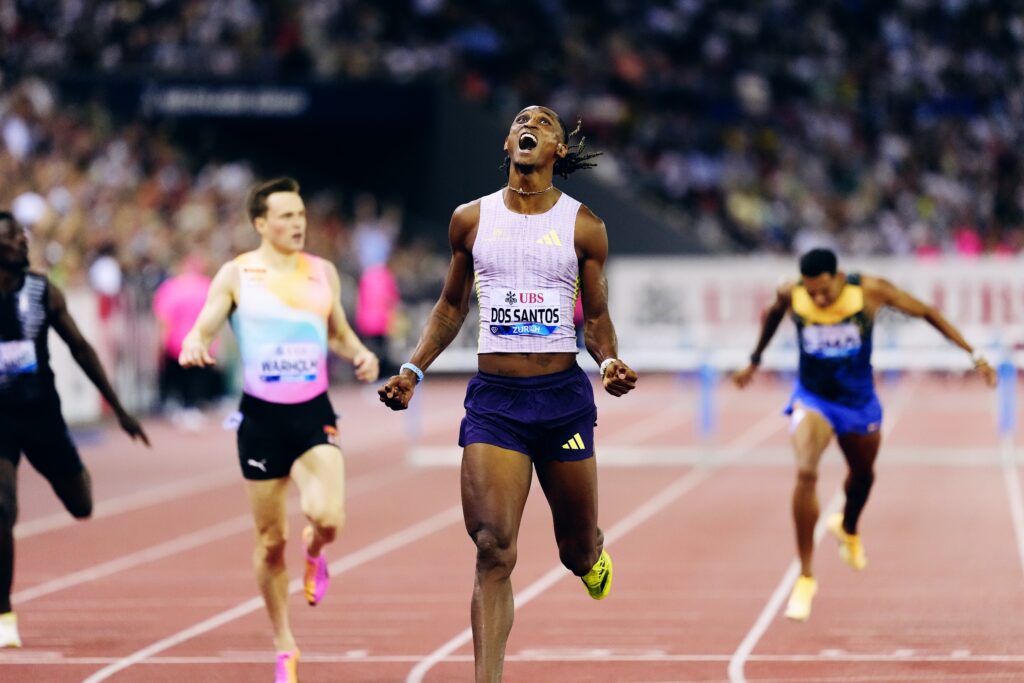
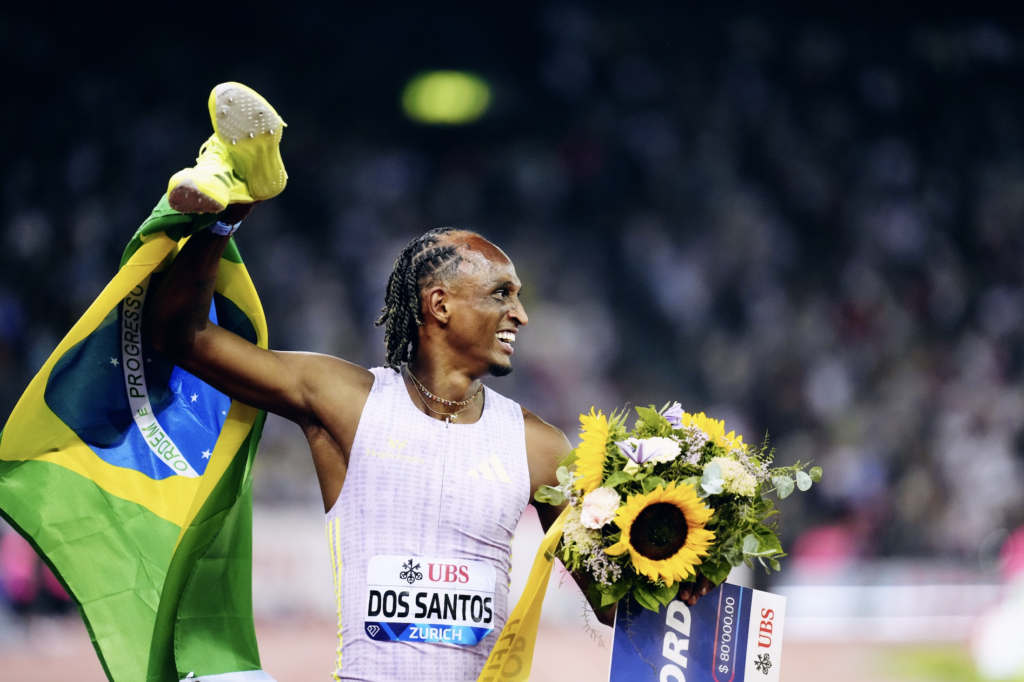
First came Alison dos Santos.
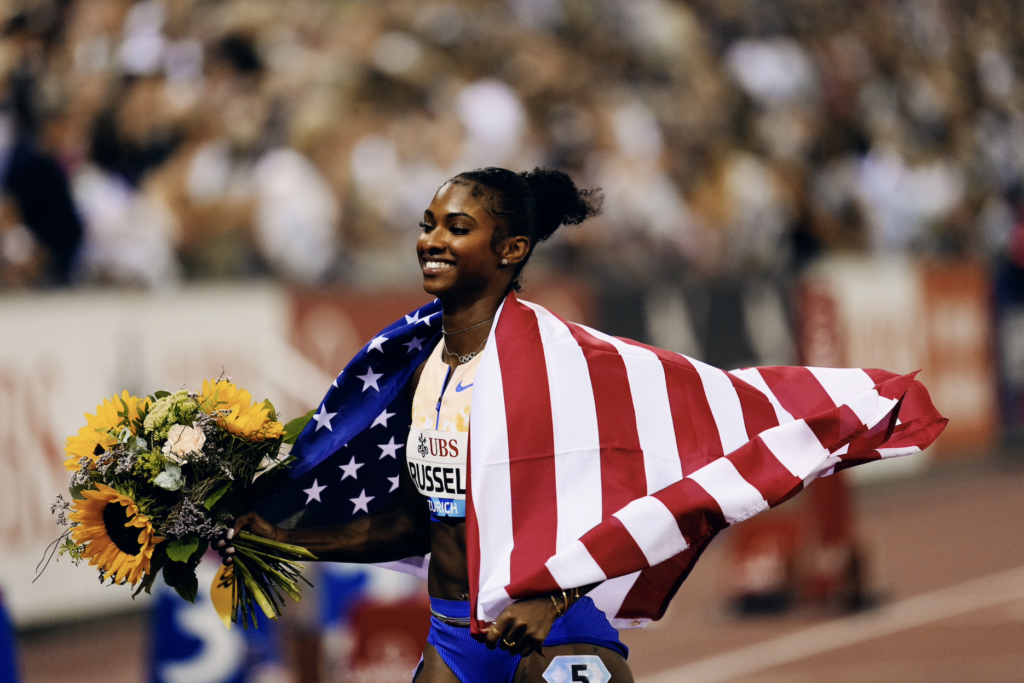
Then, less than 40 minutes later, Masai Russell.
Two hurdles races. Two world records. Two athletes who had begun their Diamond League campaigns months earlier in Shanghai, where the season’s opening chapters offered tantalising hints of what was to come.
It was not simply a remarkable night in Zurich.
It was the culmination of a season-long escalation.
The absurdity of 45.80
The men’s 400m hurdles has spent the last decade making a mockery of what once seemed physically possible.
Karsten Warholm pushed the event into another dimension. Rai Benjamin followed him there. Alison dos Santos became one of the men capable of living in that rarefied space.
Warholm’s 45.94, set when he won Olympic gold in Tokyo in 2021, had survived for five years. It was one of those records that seemed less like a target than a landmark: astonishing enough to define an era.
Then came Zurich.
Dos Santos had already spent much of 2026 building an argument that the record was vulnerable. He arrived in Switzerland having run 46.43 in Silesia, A world leading time this season, while defeating Warholm once again.
But there is an enormous psychological distance between running 46.43 and running 45.80.
That is what makes a world record so outlandish.
Dos Santos did not merely shave something from Warholm’s benchmark. He took 0.14 seconds from a record that had already looked almost superhuman.
And he did it against Warholm.
The Brazilian began behind the Norwegian on the stagger, but by halfway he had eaten into the deficit. Then came the closing stages: clean hurdle clearances, relentless speed and a finish that turned a rivalry into a changing of the guard. The clock read 45.80.
For context, Dos Santos had entered the season with a 400m hurdles personal best of 46.29, set in 2022. In the space of one evening, he ran nearly half a second faster than that old lifetime standard and faster than anyone in history.
That is not an improvement.
That is an event being redrawn.
And then Russell made Zurich even bigger
A world record usually gets the evening to itself.
Russell apparently had other plans.
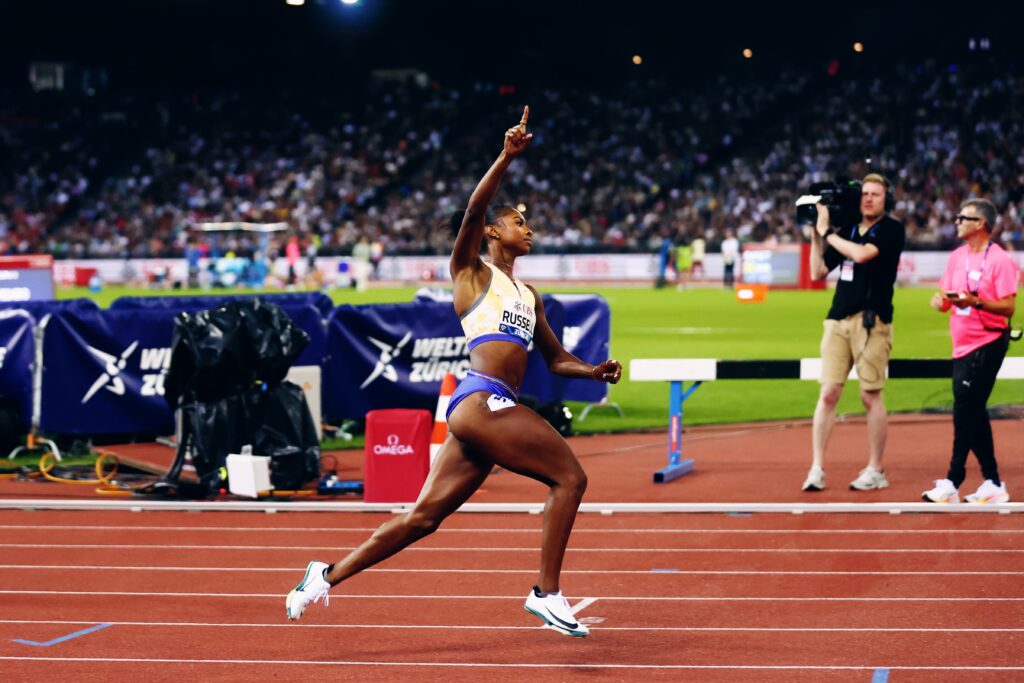
Less than 40 minutes after Dos Santos’ 45.80, the American Olympic champion stepped into the 100m hurdles and produced a performance every bit as extraordinary.
12.09 seconds.
Tobi Amusan’s world record of 12.12 had stood since the 2022 World Championships. Russell had spent months chasing it, getting closer and closer until the record began to feel less like a distant possibility and more like an appointment waiting to be kept.
In Zurich, she arrived at that appointment.
And there was no wind to explain it away.
Russell’s 12.09 came in completely still conditions — 0.0 m/s — making the performance even more striking. Amusan, the woman whose record she was chasing, was in the race and finished second in 12.23.
The image was almost too perfect: the old world-record holder on the track, the Olympic champion in front, and the clock finally moving beyond a barrier that had resisted for four years.
Russell had dreamed about this moment. Now she was its author.
And the most remarkable part may be that Zurich did not come out of nowhere.
Shanghai was the warning
Cast your mind back to May 16.
The Diamond League season had barely begun when Shanghai/Keqiao provided its first glimpse of the athletes these two could become.
Russell won the women’s 100m hurdles in 12.25, setting a meeting record. But the result was more than an early-season victory. Behind her were Devynne Charlton in 12.38 and Amusan in 12.41. A world-class field already operating at an extraordinary level.
For Russell, Shanghai was the first statement.
For Dos Santos, it was the opening act of a rivalry.
He lined up against Warholm over the unusual 300m hurdles distance and won in 33.01, with Warholm only four hundredths behind in 33.05. The race was designed as a slightly unconventional test, but the message was unmistakable: Dos Santos had arrived with speed.
That mattered.
The Brazilian had spoken before the season about developing greater speed. His Shanghai performance suggested that the experiment was working.
Nobody in Keqiao could have known exactly where the season would lead.
But perhaps, in retrospect, the clues were already there.
Russell spent the summer hunting 12.12
Russell’s progression was almost cinematic.
Shanghai: 12.25.
One week later in Xiamen: 12.14.
That second performance was astonishing on its own. It was an American record, a Diamond League record and the second-fastest time in history. Just two hundredths from Amusan’s world record. And she did it with Amusan, Charlton, world champion Ditaji Kambundji and two-time world champion Danielle Williams among her opponents.
Russell was no longer talking about whether she could break the world record.
She was talking about when.
“I’ve been saying all year that I’m going to break the world record,” she said after Xiamen.
The season became a pursuit.
She won in Eugene in 12.24. Then Monaco in 12.20. Lausanne followed with 12.27. Every race kept the pressure on the record and, perhaps more importantly, kept Russell racing against the very best hurdlers in the world.
And the competition was not merely decorative.
Amusan was finding her form again. Kambundji was the reigning world champion. Charlton was one of the world’s most accomplished sprint hurdlers. Nadine Visser, Grace Stark, Danielle Williams and Ackera Nugent were all part of an event that had become brutally deep.
By Zurich, Russell was not simply trying to run faster than a number on a scoreboard. She was trying to remain ahead of an entire generation of elite hurdlers.
Then she ran 12.09.
Dos Santos had his own gauntlet
The Brazilian’s path was different, but the destination was remarkably similar.
Shanghai gave him Warholm.
Xiamen gave him Warholm again. This time over 400m, where Dos Santos ran 46.72 to beat the Norwegian’s 46.82.
Then came Stockholm.
Oslo.
And, eventually, Silesia.
At Silesia on August 23, just four days before Zurich, Dos Santos lowered his world-leading mark to 46.43, with Warholm again second in 46.52. The two performances ranked among the fastest in history.
There was something almost old-fashioned about the rivalry: two great athletes repeatedly lining up against one another, refusing to allow the other to dictate the narrative.
Warholm had the history.
Dos Santos had the momentum.
By Zurich, the Brazilian had beaten his great rival in every head-to-head race of 2026.
Still, nobody gets a world record simply because the numbers say they are ready. The final step is always the most difficult.
The strange poetry of the Diamond League
This is perhaps what makes the Zurich story so compelling for Shanghai.
The Diamond League season is not one race. It is a travelling pressure cooker.
Athletes move from city to city, continent to continent, climate to climate. They race champions, Olympic medalists, world champions and athletes who may be anonymous to the wider public but are capable of producing the fastest race of their lives on any given night.
Shanghai was the beginning.
Zurich was the crescendo.
In between came the accumulated evidence: Russell inching towards 12.09; Dos Santos repeatedly defeating Warholm; both athletes learning what their bodies could withstand; both discovering that the ceiling might be considerably higher than they had thought.
That is the strange thing about world records.
We talk about them as singular moments, but they are rarely singular achievements.
A record-breaking race lasts seconds.
The road to it lasts years.
World records are often portrayed as lonely achievements: one athlete, one clock, one impossible number.
But the truth is more complicated.
Greatness needs opposition.
Russell needed Amusan, Charlton, Kambundji and the extraordinary depth of women’s sprint hurdles to keep pushing the line forward.
Dos Santos needed Warholm — and the long shadow of Warholm’s rivalry with Rai Benjamin — to create an environment in which 45 seconds over 400m hurdles became a legitimate frontier.
Shanghai gave both athletes that environment.
Zurich gave them history.
And if this season has taught us anything, it is that the next impossible number may already be running somewhere behind them.